Seasonal crawling insect migrations along the Milk River Valley follow predictable shifts in atmospheric moisture and sub-zero freeze patterns. In neighborhoods like Highland Park and the Saddle Butte area, residential…
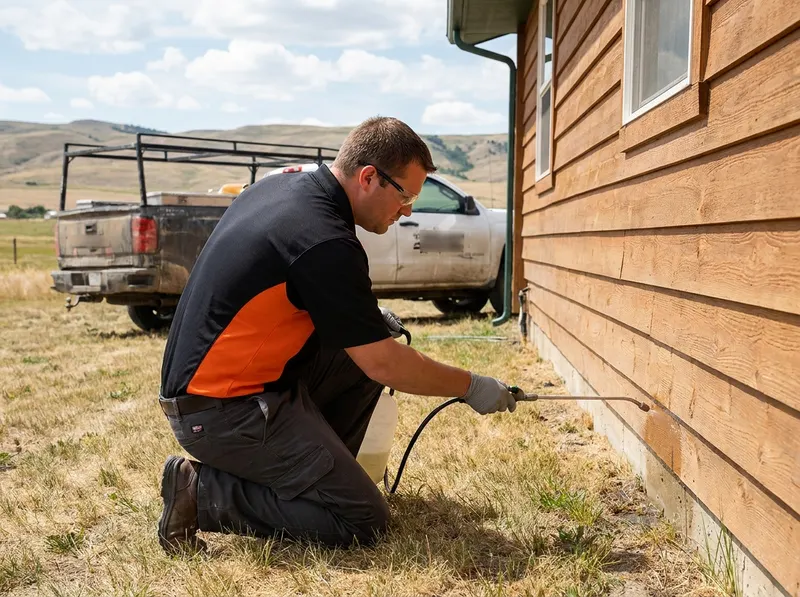
Seasonal crawling insect migrations along the Milk River Valley follow predictable shifts in atmospheric moisture and sub-zero freeze patterns. In neighborhoods like Highland Park and the Saddle Butte area, residential foundations back up against native prairie sod where wolf spiders (*Lycosidae*) and hobo spiders (*Eratigena agrestis*) shelter in loose topsoil through midsummer. When August and September drought conditions bake the surrounding rangeland, followed immediately by first frost in late September, these arachnids migrate directly toward heated basement walls, rim joists, and crawlspace vents. A standard retail pyrethroid spray breaks down under intense solar ultraviolet exposure within 14 days, leaving entry points unprotected. Professional barrier defense establishes a continuous multi-zone perimeter using UV-stable microencapsulated formulations applied 3 feet up the exterior concrete foundation and 3 feet out onto surrounding soil, gravel, or apron concrete.
Older construction profiles common to the Downtown Havre Historic District and Sunnyside present structural vulnerabilities that chemical barriers alone cannot resolve. Mortar erosion in sandstone foundations, unsealed dryer vents, and gaps around water meters allow boxelder bugs and centipedes easy access behind baseboards. Technicians inspect these specific ground-level ingress zones, physically sealing gaps measuring up to one-half inch using copper mesh backing and elastomeric sealants. In slab-on-grade developments near Meadowlark and Devonshire, defense focuses heavily on sliding-door tracks, garage expansion joints, and threshold transitions where concrete settled unevenly after harsh freeze-thaw cycles. Micro-crystalline dust deposits are blown into unfinished basement sill plates and crawlspaces, creating a residual desiccating layer that stays active in damp, unheated subterranean zones for up to 90 days.
Properties bordering agricultural perimeter roads or drainage ravines in North Havre and near the Montana State University-Northern campus face higher insect populations due to dense brush and field margins. Property owners face a practical trade-off between exterior perimeter exclusion and full interior crack-and-crevice dusting: an exterior-focused program completely prevents pesticide residues inside the living areas while stopping 85 to 90 percent of seasonal infiltrations, whereas heavy existing indoor infestations require direct interior baseboard treatments alongside basement containment. For standalone single-family homes, treatments cover the primary residential footprint; detached shops, historic carriage houses, and pole barns require separate perimeter yard runs to ensure complete barrier integrity across the entire parcel.
Every job gets a firm, written price after a free on-site visit.
Tell us about your seasonal spiders and crawling insect defense job in Havre and we'll send a clear, written quote, usually the same day.
 Varnexa Pest Defense