Varnexa Pest DefenseVarnexa Pest Defense

Carpenter Ant and Wood-Boring Insect Treatments Havre

Structural timber pests in Northern Montana behave differently than metropolitan variants due to rapid freeze-thaw cycles and seasonal river valley moisture. Unlike termites that ingest cellulose, carpenter ants hollow…
Get My Free Estimate →(406) 808-6022
Carpenter Ant and Wood-Boring Insect Treatments in Havre, MT
Quick answer
  • Service scope: Moisture-source identification, localized acoustic and tactile inspection, wall-void micro-injections, and external structural perimeter barrier treatments.
  • Response dispatch: Initial site evaluations across Havre occur within 24 to 48 hours, with urgent structural containment scheduled around active swarm periods.
  • Baseline cost: Service pricing starts at the $150 minimum diagnostic charge, scaling to between $275 and $650 depending on linear footage and void accessibility.
  • Targeted insects: Camponotus vicinus carpenter ants, powderpost beetles, wood-boring buprestids, and opportunistic dampwood invaders nesting in framing lumber.
  • Scheduling process: Direct dispatch intake is initiated by contacting (406) 808-6022, after which a technician conducts an on-site structural moisture and damage audit.

Structural timber pests in Northern Montana behave differently than metropolitan variants due to rapid freeze-thaw cycles and seasonal river valley moisture. Unlike termites that ingest cellulose, carpenter ants hollow out softwood studs, joists, and sill plates strictly for gallery space, leaving behind piles of coarse, sawdust-like frass containing insect fragments. In neighborhoods near the Milk River such as North Havre, or mature tree canopy corridors in Highland Park and Sunnyside, persistent moisture accumulation from snowdrifts and plumbing runs creates the softened wood conditions necessary for primary satellite nesting. Spraying broad-spectrum hardware-store pyrethroids across baseboards repels only foraging scouts, which splits the primary queen colony into multiple evasive sub-units inside unreachable wall cavities.

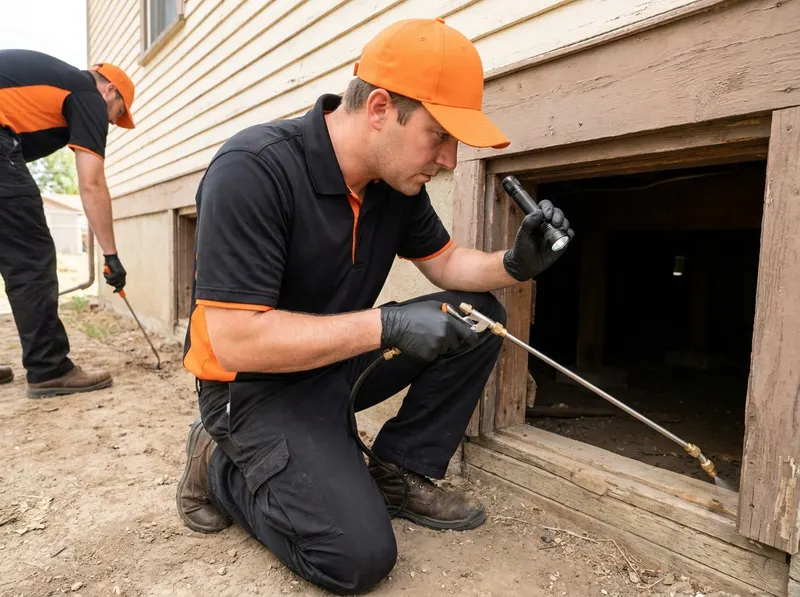
Professional treatments focus on the structural biology of the colony rather than exterior surface dampening. In the Downtown Havre Historic District, balloon-frame buildings and tongue-and-groove decking often obscure older gallery networks, requiring precision void injection of non-repellent liquid actives. Foraging ants carry these undetectable compounds back across structural thresholds to feed the queen and brood via trophallaxis. On elevated, wind-scoured parcels around the Saddle Butte area and Devonshire, wood-boring beetle larvae and satellite ant colonies frequently bridge into timber via perimeter utility penetrations, porch cantilevers, or ground-contact siding. Treatments apply a targeted chemical band 3 feet up the exterior foundation and 3 feet out onto soil or gravel to sever perimeter trailing routes.

Structural remediation follows a sequenced progression. Step 1: Technicians map interior relative moisture levels and timber integrity with moisture meters to pinpoint active gallery centers behind drywall or beneath crawlspace subfloors. Step 2: Wall plates or baseboard seams receive precise 1/8-inch drill-and-inject micro-applications, placing active transfer foam directly into nesting corridors. Step 3: Foundation borders receive a sustained non-repellent perimeter application designed to intercept seasonal trailing. Step 4: The property owner receives an actionable carpentry and moisture-abatement punch list to eliminate plumbing leaks, roof valley backups, or unventilated crawlspace humidity that attracts re-infestation.

Carpenter Ant and Wood-Boring Insect Treatments cost in Havre

Initial Structural Inspection & Diagnostic Void Drill$150, $225
Targeted Single-Room or Joist-Bay Void Injection$250, $375
Comprehensive Interior & Exterior Structural Elimination$375, $650
Outbuilding, Pole Barn, or Multi-Structure Timber Treatment$450, $900

Every job gets a firm, written price after a free on-site visit.

Common questions

How can Havre property owners distinguish carpenter ant damage from termite damage?
Carpenter ant galleries in Havre structures leave clean, smooth, sanded-looking interior wood walls clear of mud, accompanied by visible piles of wood frass. Termite activity, which is extremely rare along the Hi-Line, packs mud and soil directly into ragged galleries to maintain high ambient humidity.
Will drilling into walls cause visible cosmetic damage to Havre homes?
Diagnostic and treatment holes are limited to small 1/8-inch apertures placed discretely along baseboard lines, grout joints, or crawlspace headers. Technicians seal these micro-drill ports flush after injecting active treatment products.
How fast do carpenter ant colonies die off after structural treatment in Havre?
Complete colony collapse takes between 14 and 30 days because non-repellent materials must circulate biologically through the worker hierarchy to the queen. Interior scout sightings often increase temporarily over the first 72 hours as gallery stress disrupts normal trailing behavior.
Are treatments safe around crawlspaces and basements common to older Havre properties?
Applied products bind tightly to wood fiber and dry soil matrixes without volatile airborne off-gassing into interior living areas. Subfloor injections remain confined inside locked framing voids, isolating the chemistry from domestic living quarters.
Does exterior freezing weather in Havre stop wood-boring insect treatments?
Interior void injections and structural barrier applications proceed year-round because internal framing remains warm enough for active timber pests. Exterior ground liquid applications are scheduled around sub-zero frozen soil conditions to prevent runoff.

Get started today

Tell us about your carpenter ant and wood-boring insect treatments job in Havre and we'll send a clear, written quote, usually the same day.

Get your free pest control services quote, Havre

We only use your ZIP to check availability, no spam.